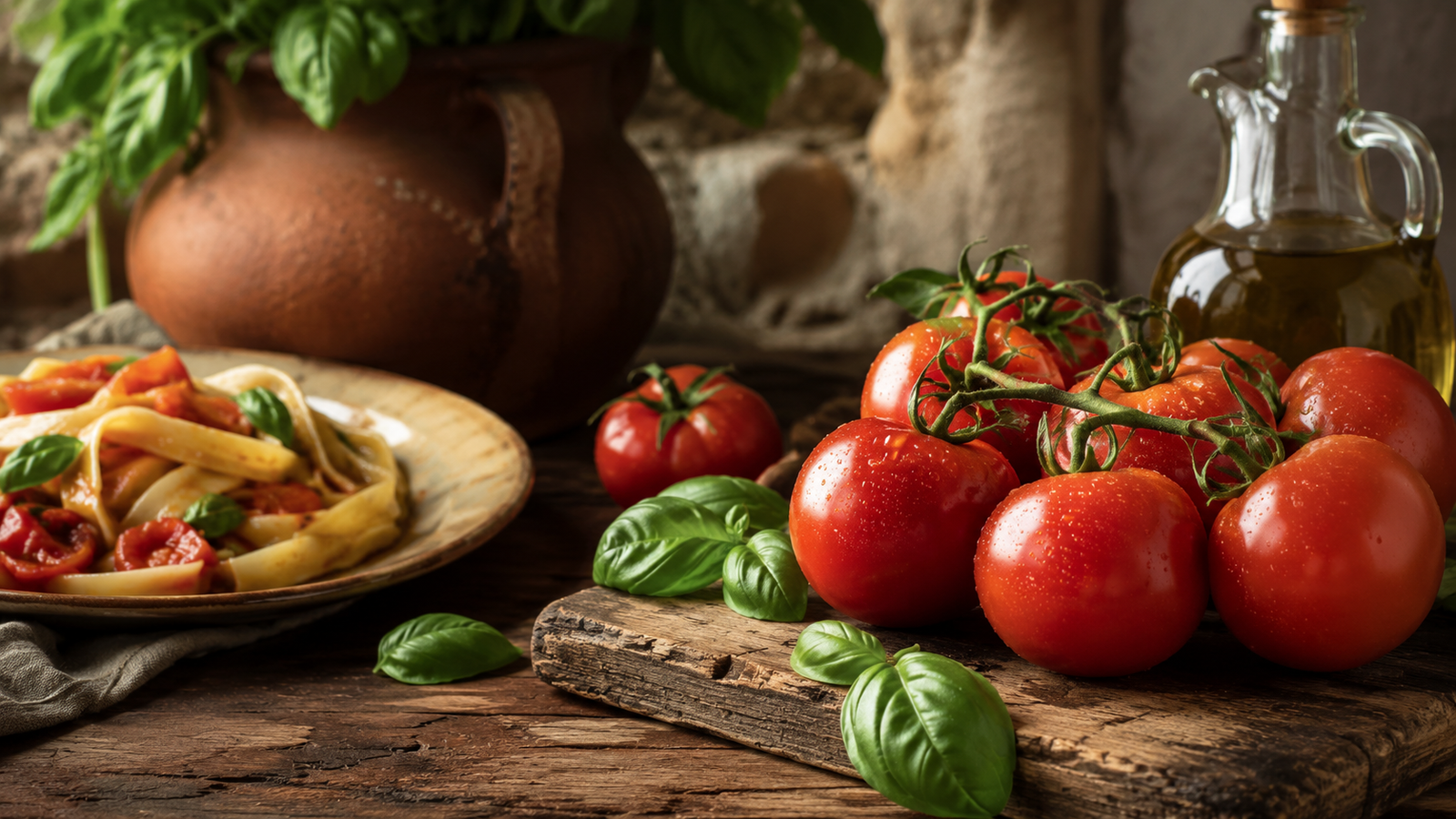
How tomatoes transformed Italian cuisine is one of the clearest examples of how an ingredient can travel across the world and eventually become inseparable from a national food culture. Tomatoes are now associated with pasta sauces, pizza, bruschetta and countless regional dishes, but they did not originate in Italy — or anywhere in Europe.
Tomatoes arrived in Europe, including the Italian peninsula, during the sixteenth century after being carried across the Atlantic from the Americas. Italians did not immediately adopt them as an everyday food. Their importance in cooking developed gradually over the following centuries, especially in southern Italy.
Where Did Tomatoes Come From?
The tomato’s story began thousands of kilometers from Italy.
Wild relatives of the tomato grew in western South America, particularly around the Andean region. Over time, varieties of the plant moved north, and tomatoes were domesticated and cultivated in Mesoamerica before Europeans arrived.
Indigenous communities in present-day Mexico were already using tomatoes in cooking. They combined them with ingredients such as chilies and other local foods, creating sauces and preparations long before the tomato became familiar to Europeans.
Spanish explorers and colonists encountered tomatoes during the sixteenth century and carried seeds across the Atlantic.
This movement was part of what historians later called the Columbian Exchange: the large-scale transfer of crops, animals, diseases and people between the Americas and the Old World after 1492.
Tomatoes joined other American foods such as potatoes, maize, cacao and chili peppers on journeys that would eventually transform cuisines far beyond their places of origin.
When Did Tomatoes Arrive in Italy?
Tomatoes arrived in Italy during the sixteenth century, after Spanish contact with the Americas brought the crop across the Atlantic. They reached several parts of Europe during this period, including the Italian peninsula.
Early European descriptions suggest that tomatoes were initially treated as unusual botanical specimens. They appeared in gardens and attracted attention for their striking shapes and colors.
In Italy, the tomato became known as the pomodoro, a word traditionally interpreted as “golden apple.” Early European tomato varieties may have included yellow-colored fruits, which helps explain the name.
But simply arriving in Italy did not make tomatoes immediately important to Italian cooking.
For generations, they remained relatively marginal.
That slow acceptance is important because it challenges the modern assumption that tomatoes and Italian cuisine have always belonged together.
They did not.
Their relationship had to be created.
Why Europeans Were Suspicious of Tomatoes
When tomatoes first appeared in Europe, many people treated them as ornamental plants rather than everyday food.
Part of the hesitation came from unfamiliarity. European diners had no established culinary tradition explaining how tomatoes should be prepared or what foods should accompany them.
The tomato also belongs to the nightshade family, which includes plants Europeans already associated with toxicity. This connection contributed to uncertainty around the new crop.
Attitudes were not identical everywhere, however. Southern European climates were well suited to tomato cultivation, and cooks gradually experimented with the fruit.
Tomatoes offered several useful qualities.
They were colorful, acidic, relatively easy to cook and capable of adding moisture and depth to otherwise simple foods.
Those qualities would eventually make them especially valuable in southern Italian kitchens.
When Did Italians Start Using Tomatoes in Cooking?
There was no single moment when Italians suddenly began eating tomatoes. Their adoption happened gradually, with tomatoes becoming increasingly important in southern Italian cooking over several generations.
They became particularly common in and around Naples. The region’s warm climate provided good growing conditions, while dense urban populations created demand for inexpensive and flavorful foods.
For poorer communities, tomatoes had practical advantages. They could be grown locally and combined with staples such as bread, vegetables and pasta.
Cooking also changed the fruit.
Raw tomatoes have brightness and acidity, but slow cooking concentrates their flavor. Combined with olive oil, garlic, herbs or onions, tomatoes could form a rich sauce from inexpensive ingredients.
This was one of the crucial steps in how tomatoes transformed Italian cuisine: Italian cooks did not merely adopt the fruit. They developed techniques that made it fit existing local foods and tastes.
The imported ingredient became increasingly Italian through the way it was cultivated, prepared and combined.
How Tomato Sauce Became Part of Italian Cuisine
By the eighteenth and nineteenth centuries, recipes using cooked tomatoes were becoming much more established in southern Italian cooking.
Tomato sauce proved remarkably adaptable.
It could accompany vegetables, meat, fish and eventually pasta. Its acidity balanced richer ingredients, while its natural sugars developed during cooking.
The sauce also worked well with several ingredients already central to Mediterranean cooking, including olive oil, garlic and herbs.
This combination was inexpensive enough for ordinary households but flavorful enough to spread far beyond them.
Over time, tomato sauce became one of the foundations of what international diners now recognize as Italian food.
Yet even within Italy, there was never just one tomato sauce.
Regional cooks developed different preparations depending on local ingredients, traditions and preferences. Some sauces were cooked quickly and remained bright and fresh. Others simmered slowly and developed deeper flavors.
The tomato became useful precisely because it could adapt.
From Tomato Sauce to Pasta
Pasta existed in Italy long before tomatoes arrived.
For centuries, pasta was eaten with ingredients such as cheese, spices, fats and other sauces. The modern assumption that pasta naturally requires tomato sauce would have made little sense to earlier generations.
Once tomatoes became common in southern Italian cooking, however, the combination proved extraordinarily successful.
Pasta provided inexpensive energy and a neutral base. Tomato sauce added acidity, moisture, color and flavor.
Together they created a dish that was relatively simple to prepare, adaptable and satisfying.
During the nineteenth century, pasta with tomato-based sauces became increasingly prominent, especially in Naples and southern Italy.
Eventually, the pairing spread through Italy and followed Italian emigrants abroad.
Today, pasta and tomato sauce seem almost inevitable.
Historically, they were a fusion between an older Italian staple and a crop that had crossed the Atlantic.
Tomatoes and the Birth of Modern Pizza
Pizza tells a similar story.
Flatbreads existed in the Mediterranean world long before tomatoes reached Europe. In Naples, inexpensive flatbreads became popular street food among working people.
Adding tomatoes changed them.
Tomatoes provided a flavorful topping that was cheap, colorful and easy to combine with ingredients such as cheese, garlic and herbs.
During the nineteenth century, tomato-topped pizza became increasingly associated with Naples.
From there, pizza would eventually become one of the most globally recognizable foods associated with Italy.
The transformation is striking.
An American crop was placed on an old Mediterranean form of bread, developed within the food culture of Naples, and later carried around the world by migration and commerce.
Pizza is therefore not evidence that cuisines remain unchanged. It demonstrates exactly the opposite.
Why Southern Italy Played a Central Role
The tomato did not reshape every part of Italy in the same way or at the same speed.
Northern Italian cooking historically relied heavily on foods such as butter, rice, polenta and cheeses. Southern regions were generally more closely associated with olive oil, vegetables and, eventually, tomatoes.
Climate mattered as well.
Tomatoes thrived in warm southern conditions, making places such as Campania especially important in the development of tomato-based cooking.
Different regions also developed preferences for particular tomato varieties and preparations.
Around Naples and Mount Vesuvius, tomatoes eventually became deeply connected to the local agricultural landscape. Varieties valued for sauces gained reputations that continue today.
This regional diversity matters because “Italian cuisine” is really a collection of many local cuisines.
The tomato became a national symbol, but its path into Italian food was strongly regional.
Canning Helped Tomatoes Travel Further
Technology helped turn the tomato from a seasonal crop into an ingredient available throughout the year.
Fresh tomatoes are highly perishable. Before modern preservation, their usefulness was closely tied to harvest seasons.
During the nineteenth and early twentieth centuries, improvements in food preservation and industrial canning changed that.
Tomatoes could be processed, packed and transported over long distances.
Southern Italy developed an important tomato-processing industry, making canned tomatoes and sauces increasingly available domestically and internationally.
This development helped standardize some tomato-based dishes while also allowing Italian migrants to reproduce familiar flavors in new countries.
The tomato was no longer limited by harvest season or geography.
It had become an industrial food product as well as a fresh agricultural ingredient.
Italian Migration Made Tomato Dishes Global
Millions of Italians emigrated during the late nineteenth and early twentieth centuries, particularly to the Americas.
They carried food traditions with them.
Italian communities abroad adapted recipes to local ingredients, economic conditions and new audiences. Pasta with tomato sauce and pizza were particularly well suited to this process.
In countries such as the United States, Italian immigrant foods gradually moved beyond ethnic neighborhoods and became part of mainstream food culture.
This expansion sometimes changed the dishes themselves.
Portions, toppings, sauces and preparation methods evolved. New foods emerged that were inspired by Italian traditions but shaped by local tastes.
Through migration, the tomato’s journey continued.
A fruit that had traveled from the Americas to Europe was now returning across the Atlantic as a central ingredient in Italian food culture.
How Tomatoes Became a Symbol of Italy
Few ingredients are now as visually associated with Italy as the tomato.
Its bright red color appears beside green basil and white mozzarella in dishes that even echo the colors of the Italian flag.
Tomato sauces define internationally famous pasta dishes. Tomatoes are central to many pizzas, salads, soups and regional preparations.
Yet the tomato became “Italian” not because of where the plant originated, but because generations of Italian farmers and cooks gave it new meanings.
They selected varieties suited to local environments. They developed cooking methods around it. They paired it with existing ingredients. They made it part of everyday meals.
Culinary identity is often created this way.
An ingredient travels somewhere new, encounters local traditions and eventually becomes so deeply integrated that its foreign origin is almost forgotten.
How Tomatoes Helped Define Modern Italian Cuisine
Today, tomatoes appear in countless Italian dishes, from slow-cooked sauces to fresh salads and regional specialties.
Different forms serve different purposes.
Fresh tomatoes can provide sweetness and acidity. Whole preserved tomatoes are prized for sauces. Tomato paste adds concentrated flavor. Sun-dried tomatoes offer a very different texture and intensity.
The ingredient’s flexibility helps explain its extraordinary success.
But tomatoes also reveal something larger about food history.
National cuisines are not sealed systems that develop in isolation. They are shaped by migration, trade, conquest, agriculture, technology and cultural exchange.
Italian cuisine existed before the tomato.
The tomato existed before it reached Italy.
What became extraordinary was the relationship that developed between them.
From Foreign Crop to Italian Icon
The history of the tomato shows how dramatically foods can change identity as they travel.
A plant with origins in the Americas crossed the Atlantic, entered European gardens, faced uncertainty, became useful to southern Italian cooks and eventually transformed some of Italy’s most famous foods.
Without that journey, modern pizza would look very different. So would countless pasta dishes and sauces now considered unmistakably Italian.
The story also reminds us that many foods we regard as ancient national traditions are actually products of global exchange.
Ingredients move.
People experiment.
Traditions change.
And eventually something foreign can become an icon.
That is what happened when tomatoes met Italy.
Explore another global food journey in Coffee’s Long Road From Ethiopia to the Modern World.
Frequently Asked Questions About Tomatoes in Italian Cuisine
Did tomatoes originate in Italy?
No. Tomatoes originated in the Americas. Wild relatives grew in western South America, and tomatoes were cultivated in Mesoamerica before Europeans carried them across the Atlantic during the sixteenth century.
When did tomatoes come to Europe?
Tomatoes reached Europe during the sixteenth century after Spanish contact with the Americas. From there, the crop spread to different parts of the continent, including the Italian peninsula.
When did tomatoes arrive in Italy?
Tomatoes arrived in the Italian peninsula during the sixteenth century. Their arrival did not immediately make them a major part of Italian cuisine, however.
When did Italians start eating tomatoes?
Italian use of tomatoes developed gradually after their sixteenth-century arrival. They remained relatively marginal for generations, becoming increasingly established in southern Italian cooking during the eighteenth and nineteenth centuries.
Why did tomatoes become so important in southern Italy?
The warm climate supported tomato cultivation, while the fruit worked particularly well with inexpensive foods and existing Mediterranean ingredients such as olive oil, garlic and herbs.
Was pasta always served with tomato sauce?
No. Pasta existed in Italy long before tomatoes arrived. Tomato-based pasta sauces became increasingly important only after tomatoes were integrated into Italian cooking.
How did tomatoes become associated with pizza?
Tomatoes became an inexpensive and flavorful topping for flatbreads in Naples. During the nineteenth century, tomato-topped pizza became increasingly popular and later spread internationally.