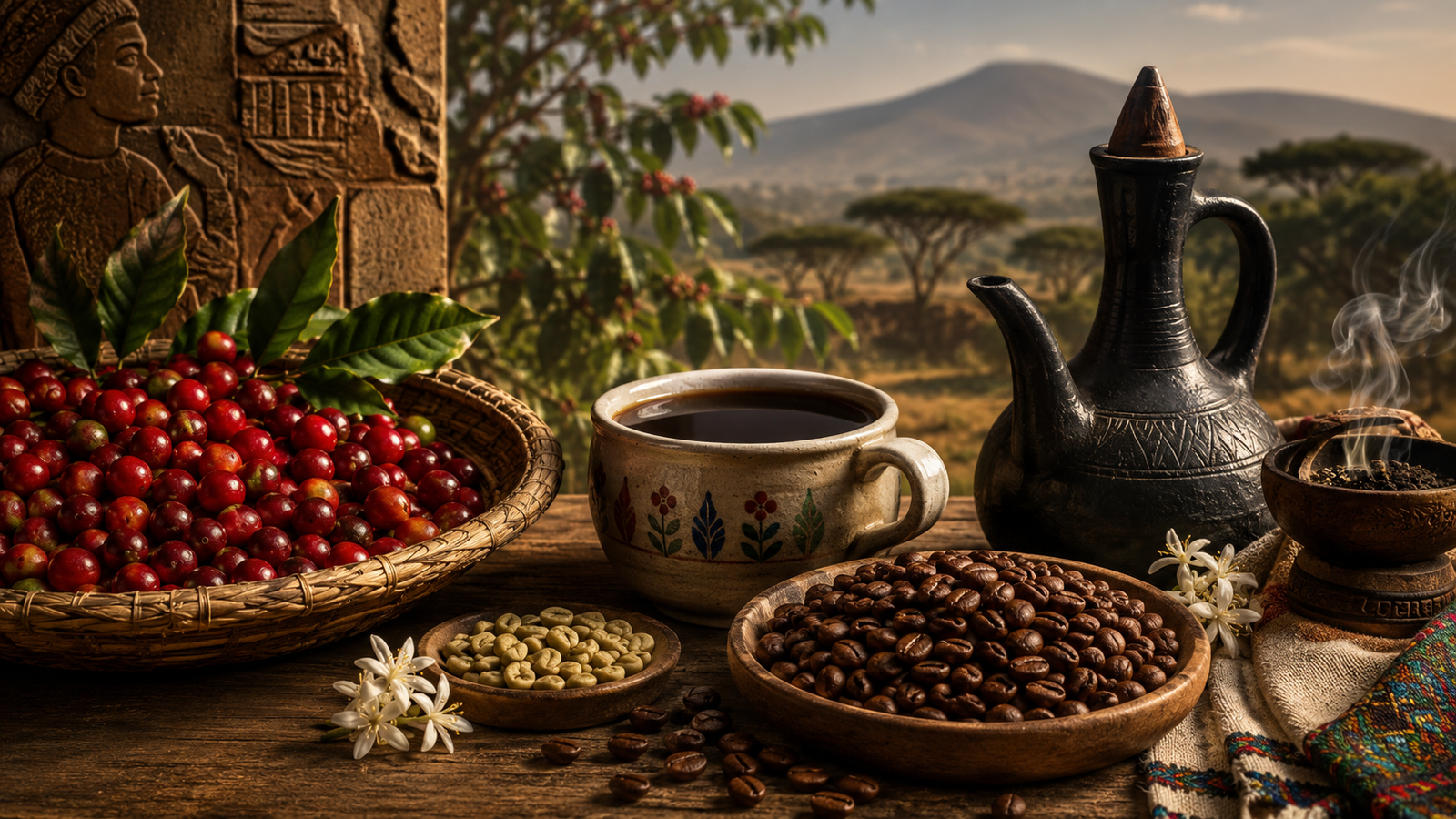
Coffee from Ethiopia traveled far beyond the highlands where its story began. From there, coffee crossed the Red Sea, entered the markets and coffeehouses of the Arabian Peninsula, and later traveled through European ports and global trading networks. Its journey transformed a regional plant into one of the world’s most influential drinks.
Coffee From Ethiopia: The Ethiopian Origins
Coffee’s connection with Ethiopia begins in the highlands, where wild coffee plants have grown for centuries. The species most closely associated with the country is Coffea arabica, the coffee plant that would eventually become the foundation of much of the world’s coffee trade.
One of the best-known stories about coffee’s discovery tells of Kaldi, an Ethiopian goat herder who noticed that his animals became unusually energetic after eating red berries from a certain plant. The story is memorable, but historians do not treat it as a documented account of coffee’s discovery. It appeared in written sources long after coffee was already being consumed.
What matters more is Ethiopia’s deep biological and cultural relationship with the plant. Long before coffee became an international commodity, communities in the region were familiar with coffee cherries and seeds and developed different ways of preparing and consuming them.
Ethiopia also remains one of the most diverse coffee-growing regions in the world. Names such as Yirgacheffe, Sidamo and Harrar have become internationally recognized, but coffee in Ethiopia is more than an export crop. The Ethiopian coffee ceremony, in which beans are roasted, ground and brewed for guests, continues to make coffee part of social and family life.
From Ethiopia to Yemen
The next major chapter in coffee’s journey took place across the Red Sea.
By the fifteenth century, coffee was being cultivated and consumed in Yemen. This is where the historical record becomes clearer and where coffee began developing into something closer to the beverage recognized today.
Sufi communities in Yemen are often associated with coffee’s early spread. The drink helped worshippers remain awake during long periods of prayer and religious observance. From these communities, coffee moved into towns, markets and ports.
Yemen also became an important center of coffee production. For centuries, the port of Mocha — or al-Makha — was closely associated with the international coffee trade. Its name eventually became so strongly linked with coffee that “mocha” survives today as a familiar term in cafés around the world.
Coffee was no longer simply a plant from the Ethiopian highlands. It was becoming a traded product.
And once merchants began carrying it beyond Yemen, its journey accelerated.
Coffeehouses and the Ottoman World
Coffee spread north through the Arabian Peninsula and into the Ottoman Empire.
By the sixteenth century, coffeehouses were appearing in major cities including Cairo, Damascus and Istanbul. These establishments were not simply places to drink coffee. They became social spaces where people met to talk, play games, listen to music, exchange information and discuss politics.
That social role made coffee unusually powerful.
Unlike many foods and drinks that remained centered around the household, coffee created public gathering places. A cup of coffee became connected with conversation, commerce and urban life.
Authorities sometimes viewed coffeehouses with suspicion because they brought large groups of people together. Attempts were occasionally made to restrict them, but the popularity of coffee proved difficult to suppress.
The coffeehouse had become part of city culture.
Soon, European merchants visiting Ottoman ports encountered both the drink and the social world surrounding it.
Coffee Reaches Europe
European contact with coffee increased through Mediterranean trade, particularly through Venice and other commercial centers connected to the Ottoman world.
During the seventeenth century, coffee began appearing more regularly in European cities.
At first it was unfamiliar and exotic. Before long, however, coffeehouses opened in places such as London, Paris, Amsterdam and Vienna.
London developed an especially influential coffeehouse culture. Different establishments attracted merchants, writers, politicians, scientists and traders. Some coffeehouses became associated with particular professions and commercial interests.
One famous example eventually gave rise to Lloyd’s of London. Edward Lloyd’s coffeehouse became a meeting place for merchants and people involved in maritime trade and insurance.
Coffeehouses could therefore function as something between cafés, offices, meeting rooms and information exchanges.
The beverage that had traveled from East Africa through Yemen and the Ottoman world was now becoming embedded in European economic and intellectual life.
But Europe faced a problem.
Most of the coffee still came from regions controlled by established producers and traders.
European colonial powers wanted coffee plants of their own.
From Trade to Colonial Plantations
During the seventeenth and eighteenth centuries, European powers began moving coffee plants into tropical colonies.
The Dutch successfully cultivated coffee in Java, part of present-day Indonesia. Java became so closely associated with coffee that the word itself is still sometimes used informally as a synonym for a cup of coffee.
The French introduced coffee to Caribbean colonies, while cultivation spread through other tropical territories.
This expansion dramatically changed coffee.
Coffee was no longer primarily a regional product traded from Yemen. It became a global plantation crop.
The growth of the industry also carried a much darker history. Many coffee plantations operated within colonial systems built on slavery, coercive labor and severe exploitation. The expanding European demand for coffee depended in many places on workers who had little or no control over the conditions under which they labored.
The global success of coffee therefore cannot be separated from the history of colonialism.
As production increased, prices fell and coffee became accessible to a much larger population.
What had once been an unusual imported drink was becoming an everyday commodity.
Brazil Becomes a Coffee Giant
Few countries changed the global coffee industry as dramatically as Brazil.
Coffee arrived in Brazil during the eighteenth century, but production expanded enormously during the nineteenth century. Large plantations developed particularly in southeastern Brazil, including areas of Rio de Janeiro, São Paulo and Minas Gerais.
By the nineteenth century, Brazil had become the dominant producer in the world coffee market.
That expansion was closely connected to enslaved labor. Enslaved Africans and their descendants performed much of the brutal work that allowed Brazilian coffee plantations to grow on such an enormous scale before slavery was abolished in Brazil in 1888.
Railways, ports and new agricultural regions later helped production expand further.
Brazil remains one of the world’s most important coffee-producing countries today, and coffee left a deep mark on the country’s economy, landscape and political development.
Coffee cultivation also spread widely across Latin America.
Colombia, Guatemala, Costa Rica and other countries developed their own coffee industries, each shaped by different climates, varieties, agricultural systems and histories.
By the beginning of the twentieth century, coffee had truly become a global crop.
The Rise of Modern Coffee Culture
The twentieth century transformed not only where coffee was grown but also how it was sold and consumed.
Industrial roasting made packaged coffee widely available. Instant coffee offered convenience and became especially popular during periods of war and rapid urbanization.
Large brands turned coffee into a standardized mass-market product.
At the same time, different countries maintained distinctive coffee traditions.
Italy developed espresso culture. Turkey preserved finely ground coffee brewed in traditional pots. France became associated with café terraces. In Brazil, the small and strong cafezinho became an everyday gesture of hospitality.
In the United States, diners and office coffee became part of daily routine.
Later in the century, chains helped popularize espresso-based drinks on a huge international scale.
Coffee had completed another transformation: from commodity to lifestyle.
The Specialty Coffee Movement
Beginning in the late twentieth century and accelerating in the twenty-first, consumers became increasingly interested in where their coffee came from.
The specialty coffee movement placed greater emphasis on origin, variety, altitude, processing method, roast profile and preparation.
Instead of treating coffee as a completely standardized product, roasters and cafés began presenting individual regions and farms as part of the experience.
Words such as Ethiopian, Colombian, Kenyan or Guatemalan increasingly appeared not merely as countries of production but as descriptions of flavor and identity.
This movement brought coffee’s journey full circle in an interesting way.
After centuries of global trade that often obscured the origins of the beans, consumers were once again being encouraged to think about the specific places where coffee grows.
Coffee Today: A Truly Global Journey
Coffee is now grown across the tropical regions of Africa, Asia and the Americas and consumed on almost every continent.
A single cup can represent an extraordinary chain of movement.
The plant may descend from varieties originating in Ethiopia. It may be cultivated on a farm in Brazil, Colombia or Vietnam. The beans may be processed locally, shipped through an international port, roasted in another country and finally brewed thousands of kilometers from where they grew.
Few everyday products connect so many landscapes.
Yet the future of coffee is not guaranteed.
Climate change is already affecting growing regions through rising temperatures, changing rainfall patterns and increased pressure from pests and diseases. Arabica coffee is particularly sensitive to environmental conditions.
Farmers, researchers and coffee companies are therefore experimenting with new varieties, farming methods and production regions.
The next chapter of coffee’s journey may involve adapting a centuries-old crop to a rapidly changing climate.
Why Coffee’s Journey Matters
Coffee’s history is not simply the story of a popular drink.
It is a story about migration, trade, religion, empire, slavery, agriculture, industrialization and globalization.
It connects Ethiopian highlands with Yemeni ports, Ottoman coffeehouses with European trading centers, colonial plantations with Brazilian farms, and modern specialty cafés with producers across the tropics.
Every cup contains part of that journey.
Coffee began as a plant rooted in a relatively small region of East Africa. Over centuries, people carried it across seas, planted it on new continents, built businesses and social rituals around it, and transformed it into one of the most recognizable drinks on Earth.
That long road is why coffee belongs perfectly in the FoodsMania story:
food does not simply appear on our tables. It travels.
Explore another food journey in How Tomatoes Transformed Italian Cuisine.
Frequently Asked Questions About Coffee History
Where did coffee originally come from?
Coffee is strongly associated with Ethiopia, where Coffea arabica originated and where wild coffee plants have long grown. Yemen later became a crucial early center of coffee cultivation and trade.
Is the story of Kaldi and his goats true?
The story of the Ethiopian goat herder Kaldi is a famous legend, but there is no contemporary historical evidence confirming that it describes the actual discovery of coffee.
Why is Yemen important in coffee history?
Yemen played a major role in developing coffee cultivation and the drinking culture associated with it. The Yemeni port of Mocha also became one of the most famous centers of the early international coffee trade.
How did coffee reach Europe?
Coffee reached Europe largely through trade with the Ottoman world during the seventeenth century. Coffeehouses soon became popular in cities such as London, Paris and Amsterdam.
When did Brazil become important for coffee?
Brazilian coffee production expanded dramatically during the nineteenth century, eventually making the country the dominant force in the global coffee trade.